Drafted for review. Last source review: 11 October 2026. No affiliate links are used in this article.
A customer who wants to pay by card is not asking you to become a payments expert. They want the job finished and the transaction to work. You, however, need to know what reaches the business bank account, what the payment provider keeps, whether VAT applies to the provider's charge, which payment method created the fee and what happens if the customer disputes the transaction.
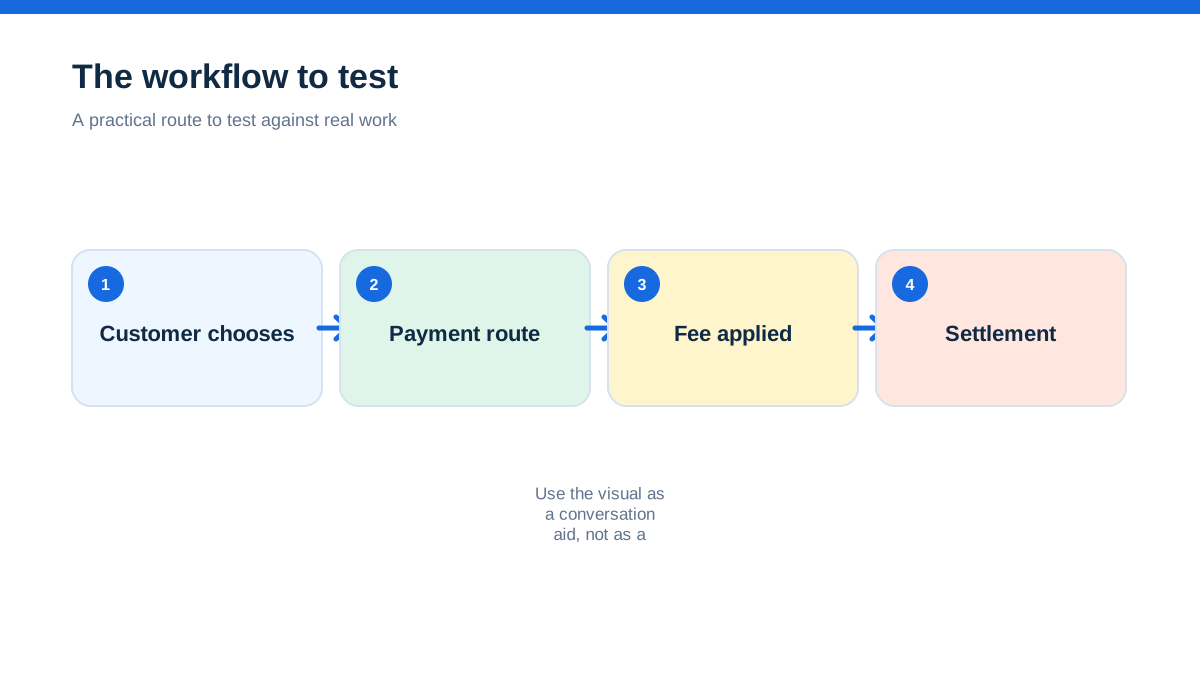
This guide compares published UK card-payment pricing for tradespeople using Stripe, Square, PayPal and PayPal Point of Sale, formerly known as Zettle. It also explains why a percentage alone is not a useful comparison. Fees vary by card type, channel, fixed charge, hardware, currency, refund, dispute and contract. The provider pages were checked on 11 October 2026. Prices and product names are changeable information, not a quote. Confirm the current page and your agreement before choosing a provider.
The emergency call-out that exposed the real fee
An electrician finishes an emergency fault-finding visit and the customer asks to pay on a card. The transaction is approved. The customer gets a receipt. Later, the electrician sees a settlement that is lower than the invoice total and assumes the missing amount is a single percentage fee.
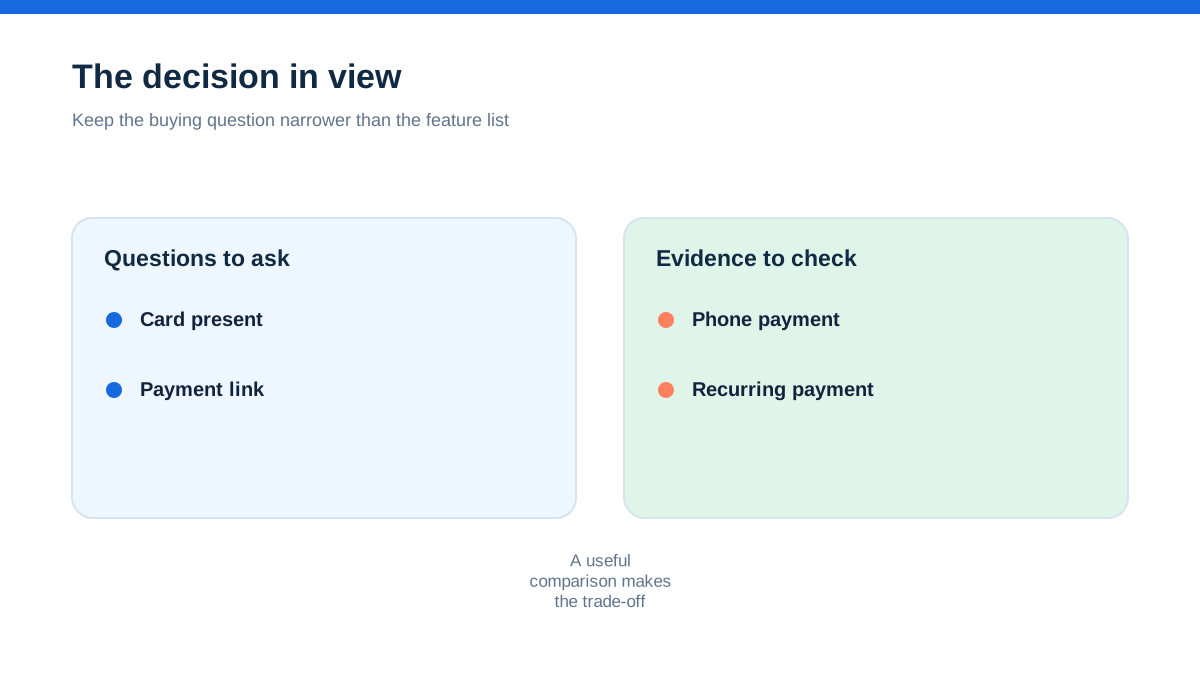
It may not be. The provider could have charged a percentage plus a fixed amount. The card could have been treated as premium or international. The payment could have used an invoice link rather than a card-present reader. A refund might return the customer’s money without returning the original processing fee. The settlement could also include several payments net of fees, making the bank entry hard to match.
The lesson is simple: compare the route the customer will actually use. A card reader at the front door, an invoice link sent by text, a keyed-in payment taken over the phone and a recurring direct debit are different payment products even when the customer's bank card is the same.
The aha: compare the payment path, not the headline rate
The aha is that the cheapest-looking rate can be the wrong answer because the payment channel changes the fee. A provider with a lower in-person rate may charge more for a remote invoice. A percentage-only tariff can be expensive for small invoices if another provider adds a fixed amount. A payment link may be convenient but carry a different fee from a chip-and-PIN transaction.
Build your comparison around three moments: the customer standing in front of you, the customer paying from an invoice later and the customer paying a recurring maintenance bill. Record the provider, channel, card category, percentage, fixed amount, hardware cost, subscription, settlement timing, refund treatment and dispute fee for each moment.
Then compare the total operating cost, not just the fee on a successful payment. Include the time spent matching settlements, handling failed payments and answering “have you received this?” A provider page may describe features such as payment links, receipts or accounting integrations, but you still need to test whether those functions fit your closing routine.
What the published UK pages show today
The following figures are examples of published standard pricing displayed on the providers' UK pages when checked on 11 October 2026. They are included to show how a comparison works, not to promise that the same rate will be available to every trade business.
| Provider and route | Published pricing to check | What it means on £100 before any applicable tax on the fee | | --- | --- | --- | | Stripe, standard UK card | 1.5% + 20p | £1.70 | | Stripe, premium UK card | 2.8% + 20p | £3.00 | | Square, in-person chip and PIN or contactless | 1.75% | £1.75 | | Square, virtual terminal or invoices | 2.5% | £2.50 | | PayPal, standard domestic PayPal payment | 2.9% + £0.30 | £3.20 | | PayPal, card processing | 1.2% + £0.30 | £1.50 | | PayPal Point of Sale, major card transaction | 1.75% | £1.75 | | PayPal Point of Sale, invoice | 2.5% | £2.50 |
Stripe's UK pricing page separates standard and premium UK cards and adds a fixed amount to the percentage. It also lists separate pricing for international cards and other payment methods.[14] Square's UK pricing page distinguishes in-person, online and manually entered or invoice payments and says its Point of Sale software has no monthly fee on the displayed plan.[15] PayPal's business pricing page separates PayPal payments, card processing and point-of-sale transactions, and states that fees are subject to change.[16]
PayPal Point of Sale's own pricing page lists separate rates for card transactions, invoices and payment links, with no recurring fee on the displayed arrangement.[17]
These examples are not interchangeable. A £100 card-present payment and a £100 invoice payment may carry different risk, support and reconciliation requirements. Confirm whether displayed prices include or exclude VAT, whether an offer is limited to new customers and whether hardware delivery or a reader purchase is extra.
Percentage plus pence punishes small invoices
The fixed element deserves attention for call-outs and small repairs. Using the published Stripe standard UK rate above, a £100 payment produces a £1.70 processing charge before any applicable tax on the fee. A £500 payment produces £7.70. At the same percentage, the fixed 20p has less effect as the invoice grows.
The reverse can happen with a provider that has no fixed element but a higher percentage. A trade business should test its real average payment values, not an attractive round number. Use at least three examples: a small diagnostic visit, a typical repair and a larger installation deposit. If the business takes a high proportion of small payments, the pence component deserves as much attention as the percentage.
Do not treat a simple example as your tax record. It is a comparison aid. The actual settlement should be checked against the provider's transaction report and the invoice in your accounting system. If one deposit covers several invoices, keep the allocation visible instead of forcing the bank entry to match a single bill.
A useful worksheet has columns for gross invoice, payment route, published percentage, fixed charge, expected provider fee, expected settlement, VAT on the provider charge where applicable and reconciliation reference. Keep the source URL and date beside the rate. That prevents an old screenshot from becoming a permanent assumption.
In-person payments are convenient, but the reader is not free
A mobile reader can turn completion into payment while you are still at the customer's premises. Square publishes an in-person rate for chip and PIN or contactless payments, while PayPal Point of Sale publishes a rate for card and contactless transactions.[15][16][17] A phone-based Tap to Pay option may avoid a separate reader, but it still depends on a compatible device, network access, account verification and the provider's current terms.
The cost of hardware is only one part of the decision. Ask how the reader is charged, what happens if it is lost, whether it works offline, how receipts are delivered and how the business identifies the payment in the accounting record. A cheap reader that cannot reliably connect outside a customer's property may be more expensive in lost time than a higher-priced device that works when needed.
Card-present evidence can also matter in a dispute. The government explains that a customer may ask their card issuer to reverse a transaction, known as a chargeback, and that card-not-present transactions carry higher risk. It also notes that a PIN can affect liability in specific circumstances, but it is not a guarantee against every chargeback.[2]
Train anyone taking payments to check the amount before confirming, give the customer a receipt and record the job reference. Never write full card details into a notebook or keep them in a customer spreadsheet.
Remote invoice payments create a different cost picture
Remote payments are useful when the customer leaves before the invoice is finalised, when a commercial client pays from an accounts department or when a deposit is collected before attendance. The customer may click a payment button on the invoice, use a hosted page or pay from a link sent by text.
The route changes the price and the evidence. Square's pricing page, for example, distinguishes online payments and virtual terminal or invoice payments from in-person payments.[15] PayPal's page distinguishes online PayPal payments, card processing and point-of-sale payments.[16] PayPal Point of Sale lists separate pricing for invoices and payment links.[17]
A remote payment should be linked to the invoice number and customer record. If the provider does not pass that reference into your accounting software, establish a daily matching routine. Keep the provider transaction ID, gross amount, fee, net settlement and payout date. This is especially important when several jobs are paid together.
For high-value installations, consider whether a card link is the best tool for the commercial arrangement. A bank transfer may be cheaper for the customer and easier to reconcile, while direct debit or bank-payment collection can suit recurring maintenance. The correct option is the one that balances customer convenience, collection risk, provider cost and your ability to explain the transaction later.
International and premium cards can change the answer
A customer may be visiting the UK, using a corporate card or paying through a digital wallet. Do not assume the standard domestic rate applies. Stripe publishes separate categories for premium UK cards, European Economic Area cards and other international cards, with possible currency-conversion charges.[14] PayPal also states that custom pricing and payment-method terms can vary for eligible businesses.[16]
If international work is rare, a conservative policy is to price the job in pounds, show the customer the total and verify the provider's treatment before accepting the payment. If international payments are common, model the currency conversion and settlement route separately. Do not quietly add an arbitrary card surcharge to consumers to recover a provider fee.
The government guidance on payment surcharges explains that rules prohibit or restrict fees for using particular payment methods in consumer transactions. The exact application depends on the payment instrument and circumstances, so check the current guidance before adding any charge.[19] The safer commercial habit is to set a transparent job price and choose payment methods that fit the margin.
The accounting treatment also needs care. A provider fee is a business cost, but the VAT treatment of that fee depends on the provider's invoice and your circumstances. Retain the provider tax document and ask your accountant how to record it. Do not infer VAT merely from the fact that the customer paid VAT on the electrical work.
Refunds, disputes and failed payments belong in the comparison
A fee comparison that considers only successful payments is incomplete. Ask what happens when a customer pays a deposit and the job is cancelled, when a duplicate payment is refunded or when the customer disputes a card transaction.
Stripe's pricing page says that, on standard pricing, processing fees from the original transaction are not returned for most payment methods when a refund is issued, and it lists a fee for received disputes.[14] Other providers have their own refund, reserve, dispute and chargeback rules. Read the current agreement rather than assuming every provider behaves like Stripe.
The practical control is evidence. Store the quote, customer acceptance, scope change, completion message, invoice, payment receipt and any refund authorisation under one job reference. For a card-present payment, retain the receipt and transaction reference. For a remote payment, keep delivery or completion evidence and the communication that explains what was supplied.
A failed payment is not an unpaid invoice in the same way as a customer refusing to pay. Record the failure reason if the provider supplies one, notify the customer without exposing sensitive details and offer an approved alternative. Never repeatedly retry a payment without a clear customer mandate or provider-authorised process.
Bank transfer, direct debit and card are not rivals in every job
Card acceptance is useful, but it should not become the only way to collect money. A customer who is comfortable with Faster Payments may prefer the bank details on the invoice. A commercial client may have a purchase-order process. A recurring maintenance customer may prefer a direct debit or bank-payment arrangement.
GoCardless describes one-off and recurring payment collection, invoice payments and integrations with accounting software such as Xero, QuickBooks and Sage.[18] That does not mean it is suitable for every electrician or every customer. Check the current UK pricing, settlement timing, mandate rules, failure handling and support before relying on it.
Offer a small number of clear choices. Put bank transfer instructions on the invoice, provide a card route for customers who need it and use recurring collection only where the customer has knowingly agreed to the arrangement. Each method needs a matching record in the accounting system.
The goal is not to force every customer through the cheapest rail. It is to avoid losing a job because the only payment method fails, while keeping the cost and risk visible enough to protect the margin.
A hands-on fee test you can run this afternoon
Take the last ten anonymised card transactions from your provider report. If you do not have ten, use every transaction available and mark the sample as limited. For each one, record the gross amount, payment channel, card category if shown, provider fee, refund or dispute status, settlement amount and payout date.
Now reproduce the same amount in each shortlisted provider's official calculator or pricing page. Do not fill missing figures with a generic comparison website. If a provider gives a quote instead of a public rate, record “quote required” and ask for the full schedule in writing.
Run the following checks:
- Compare a small, typical and large payment.
- Compare card-present with invoice or keyed-in payment.
- Add hardware, delivery and any monthly or annual charges.
- Check whether provider fees are shown with VAT or without it.
- Check refund, dispute, chargeback and payout terms.
- Test whether the transaction reference reaches your accounting software.
- Make a test payment and reconcile it to a test invoice.
Then calculate the effective cost for the sample: total provider charges divided by total gross card receipts. This is not a universal rate. It is your business's observed cost for a defined period and channel mix. Keep the formula and source documents so it can be repeated after a pricing change.
Finally, ask whether saving a fraction of a percentage would justify more admin, a new device or a weaker customer experience. A lower fee is a win only when the payment still arrives, can be matched and does not create avoidable disputes.
Tax and cashflow need their own column
Card fees reduce the amount paid into the bank, but they do not reduce the invoice total owed by the customer. If the invoice is for electrical work plus VAT, the customer payment and the provider fee are separate accounting events. Keep them separate rather than recording only the net payout as sales.
For VAT-registered businesses, HMRC requires records of sales, purchases, invoices issued and received, credit and debit notes and the VAT account, alongside relevant digital records under the applicable rules.[4] The provider's receipt or tax invoice is part of the evidence for the payment charge. If the document does not show the information your accountant needs, ask the provider how to obtain it.
Cashflow forecasting should use settlement timing rather than the card authorisation moment. A payment approved on Friday may arrive in a later payout. A reserve, refund or dispute can alter the amount. Your forecast should therefore show gross invoices, expected collection date, provider fees and expected bank receipt.
Do not use the card balance or an app dashboard as a substitute for the business bank and accounting record. Reconcile the payout, then review exceptions. When the figures do not match, investigate the transaction list before changing the invoice.
The right provider is the one that fits the job close
For a mobile electrician who mostly takes payment at the door, compare card-present cost, reader reliability, receipt delivery and next-day access to funds. For a contractor who invoices commercial customers, compare remote payment rates, references, refunds and accounting integration. For recurring maintenance, compare direct debit or bank-payment options as well as card fees.
Stripe can be attractive when you need a broad online payments platform and are comfortable checking payment-method categories and integration work.[14] Square can suit a trade business that wants a reader, Point of Sale tools and published distinctions between in-person, online and invoice routes.[15] PayPal offers online payments, card processing and point-of-sale options, with separate published rates for each.[16]
PayPal Point of Sale provides a simple card-present rate and separate invoice and link pricing on its UK page.[17]
These are not endorsements. They are starting points for a controlled comparison. Your final choice should reflect the provider agreement, the jobs you do, the devices you carry, your accounting software and your customer's preferred way to pay.
Put the fee rule beside the invoice routine
Write a short internal policy. It can say which provider is used for in-person payments, which link is used for invoices, how the job reference is entered, how refunds are approved, how payouts are reconciled and when a bank transfer is offered instead. Include the date of the current fee review and the official pricing links.
Train anyone who handles a payment to explain the total clearly, avoid prohibited surcharges, issue a receipt and report a failed or disputed transaction promptly. Recheck the provider's pricing page at a sensible interval and whenever the business changes its payment route, VAT position or average job size.
The practical win is not a perfect rate table. It is knowing, before you send the customer a payment request, what the route costs and how the resulting transaction will be proved. That is how a small trade business keeps card payments convenient without letting invisible fees or weak records eat the margin.

Affiliate status: no affiliate links are used on this page. Provider links are direct sources only, pending programme approval.