Drafted for review. Last source review: 11 October 2026. No affiliate links are used in this article.
A quote can look profitable when it is accepted and still leave very little behind when the job is finished. The difference is usually not one dramatic mistake. It is the collection of small things that were never attached to the job: an extra visit, time spent collecting a part, materials bought in a hurry, a return trip, an unapproved variation or an invoice raised before the final record was complete.
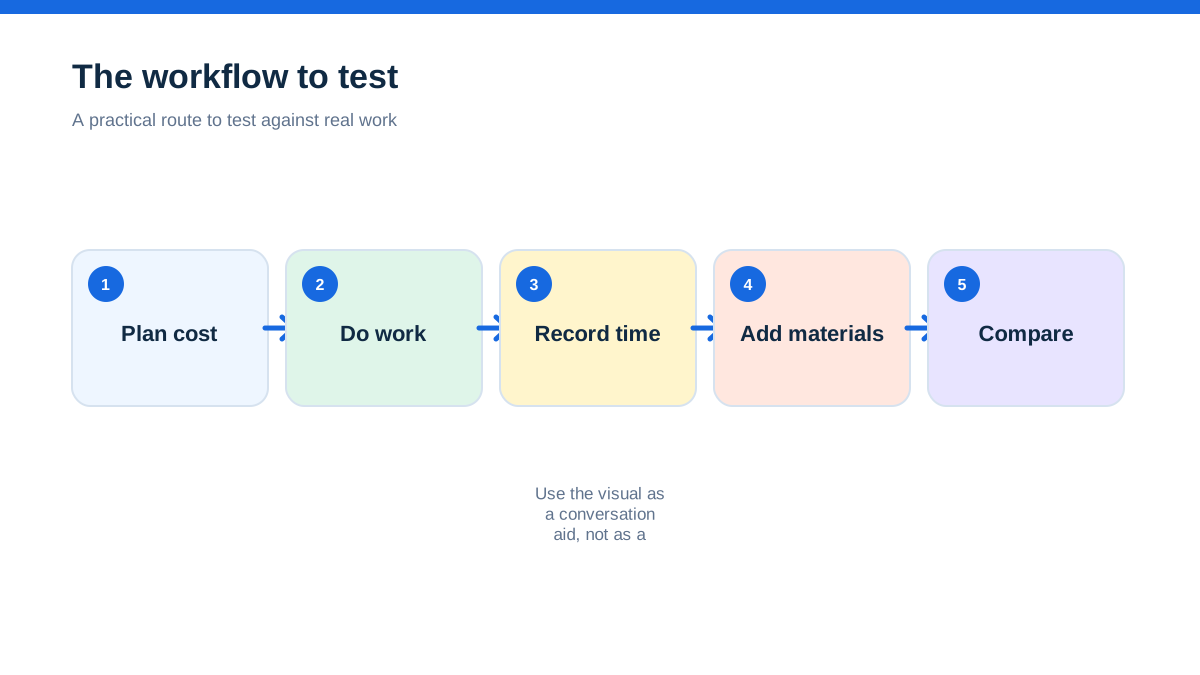
Job costing is the habit of attaching the resources used to a specific piece of work, then comparing them with what was planned and what was charged. It is not the same as bookkeeping, and it is not a demand for elaborate accounts. It is an operational record that helps a small trade business price future work and see where a current job needs attention.
This guide gives a hands-on method for costing jobs with a spreadsheet, job-management software or a combination. It uses UK terms and points to official HMRC guidance where record-keeping and accounting treatment matter. It does not tell you how to calculate your tax return. Speak to an accountant about the method that applies to your business.
The central idea is simple: a job is not financially understood when the invoice is sent. It is understood when the planned resources, actual resources, change decisions and final charge can be read together.
The quote that looked fine until the van came back
Imagine opening a completed job and seeing a single sales value. The invoice is correct. The customer paid. Yet nobody can say how much time the business spent travelling, sourcing a missing item, answering questions, returning to site or correcting an assumption in the original scope.

Those activities did not vanish. They were paid for by the job, even if no one recorded them against it.
Start with one completed job and reconstruct it from the records you already have. Find the accepted quote, purchase receipts, staff or subcontractor time, vehicle notes, customer changes, invoice and payment. Do not try to produce a perfect historical account. Mark each item as known, estimated or missing.
This exercise reveals what the business can currently see. It may show that materials are captured but time is not, or that the invoice is clear but variations are buried in messages. It may show that the job is profitable only if the owner’s time is treated as free. That is not a criticism of the people doing the work. It is a visibility problem.
For the next job, create a job cost card before work begins. The card can be a page, a record or a linked table. It needs a job reference, customer and site, quoted or agreed value, planned labour, planned materials, planned subcontractor or specialist costs, expected visits, known exclusions and a place for changes.
Leave the card open until the job is fully reviewed. If it disappears when the invoice is raised, it cannot teach you anything about the next quote.
Decide what “cost” means for your business
The word cost can describe several different things. A purchase receipt is a direct cost. An electrician’s time is a labour cost. Travel may be recorded as mileage, paid time, vehicle expense or an overhead allocation, depending on how the business operates. Software, insurance, rent and phones are usually shared overheads rather than costs belonging to one job alone.
Write your definitions down before building a report. Otherwise two jobs can appear comparable while using different rules.
A useful starting split is:
- direct materials bought for the job
- materials taken from existing stock
- labour or subcontractor time used on the job
- travel and other job-specific expenses
- shared overhead allocated for planning purposes
- customer charge, including approved extras
Do not force every expense into a job if the link is artificial. The purpose is to make decisions better, not to create false precision. A small business may initially track direct materials and time reliably, then add travel or overhead allocation once the basic capture is working.
Keep cost and price separate. The cost card describes what the business uses. The quote or invoice describes what the customer pays. A markup can be applied to materials or labour, but it does not change the underlying resource used. Recording only the selling value hides the difference between efficient work and work that required more input than expected.
Also distinguish a cost from a payment. A supplier invoice may arrive after the work, and a customer may pay after the invoice. The operational question is what the job used and what the business charged. The tax or accounting question may depend on the accounting method and business structure.
HMRC says self-employed businesses must keep records of income and expenses and ensure that business transactions can be identified.[4][5] That is a record-keeping obligation, not a prescribed job-costing template. A job card can make the underlying records easier to understand, but it does not replace proper bookkeeping.
Build one cost card that can survive a busy day
The best cost card is the one people can complete at the moment the information exists. Make it short enough for a phone and clear enough for someone in the office to review.
Use these sections:
Job identity: job reference, customer, site, work type and person responsible.
Plan: quoted value or agreed pricing basis, planned visits, planned labour hours, planned material list, known subcontractor cost, exclusions and assumptions.
Actual labour: date, person, time on site, travel or other time if tracked, and a short description of the work completed.
Actual materials: item, quantity, source, cost, whether used, returned, held as stock or written off, and receipt reference.
Changes: what changed, why, who approved it, customer charge, additional resource required and status.
Completion: work completed, outstanding items, evidence stored, final time and material review, invoice status and learning for future quotes.
Use controlled categories rather than one long narrative. “Material”, “labour”, “travel”, “subcontractor”, “plant”, “waste”, “credit” and “other” may be enough to begin. If “other” grows, inspect it rather than adding ten more categories immediately.
Give every entry a date and person. A cost without context is hard to challenge and hard to learn from. “Cable, 45” is less useful than “cable, quantity, supplier, receipt, used on job”. Do not invent detail after the fact. Mark an estimate as an estimate and put a review action beside it.
Decide who can change the planned values and who can approve actual entries. The person doing the work should not need permission to record a part used, but a customer charge may need approval before it is added to the invoice.
Price the plan before the job starts
Before accepting work, turn the quote into a resource plan. Ask what the job needs, not just what the customer has requested.
List the expected labour by activity. A planned visit may include preparation, travel, site work, testing, customer explanation, documentation and return time. If your pricing method includes only on-site labour, record the other activities separately so you can see whether that assumption remains sensible.
List materials at the level needed to make the plan real. A generic line called “materials” is not enough if the job depends on specific equipment, fixings, containment, protection, testing supplies or disposal. You do not need a warehouse catalogue in the cost card. You do need enough detail to notice when a quote assumes that a required item is already available.
Mark uncertain assumptions. Examples include access, condition of existing work, route length, availability of a suitable supply, customer-provided items and whether another trade will be ready. An assumption is not a failure. An unmarked assumption that becomes extra work is difficult to explain.
Set a review trigger before work begins. It might be a missing part, an additional visit, a change in scope, a time threshold or an issue that makes the original method unsuitable. The trigger tells the person on site when to pause and seek a decision rather than quietly consuming the margin.
Keep the quote language aligned with the cost plan. If the quote includes a provisional item, the job record should show how that item will be confirmed. If the quote excludes remedial work, the person attending needs a place to record it and a route for customer approval.
The plan is not a prediction that must be defended at all costs. It is the baseline used to recognise change.
Capture time without turning people into timesheets
Time is often the largest missing piece in small trade job costing. The answer is not necessarily a detailed timesheet for every minute. It is a repeatable way to record enough time to compare jobs honestly.
Choose a level of detail the team can sustain. For some work, start and finish time per visit is sufficient. For longer work, split time by activity or day. If travel matters to your pricing, decide whether it is recorded separately or included in the working window. Use the same rule across comparable jobs.
Record time close to the work. Reconstructing a week from memory produces neat entries but weak comparisons. A mobile job record, a daily card or a simple end-of-day routine can work. The method matters less than consistency and a named owner.
Include the owner’s time if the owner is doing the work. A business that records an employee’s labour but treats the owner’s labour as free will produce an incomplete view. You can choose how to use that information in pricing, but you should first make the resource visible.
Do not confuse paid hours with productive work. Waiting for access, collecting materials, returning to correct an issue and writing required records may still consume business capacity. Record them using agreed categories rather than hiding them inside a rounded job total.
Use a note for unusual time. “Return visit because access was unavailable” teaches more than an unexplained extra hour. “Customer requested additional socket after quoted scope” points to a variation. “Parts collected from supplier” may suggest a stock or purchasing change.
Review time entries for completeness, not to create blame. If the team consistently cannot record time because the system is awkward, simplify the capture method. A complicated time system that is incomplete is less useful than a modest system people actually use.
Treat materials as evidence, not a memory test
Material cost is easy to understate because parts arrive through several routes. Some are bought for a specific job, some come from van stock, some are returned, and some are used to correct an earlier decision.
Create a material entry when the item is allocated or used. Record the job reference, supplier or stock source, description, quantity, cost basis and receipt reference. If the exact cost is not known at the time, mark it for later matching rather than leaving it invisible.
Decide how van and workshop stock will be treated. If the business buys a pack and uses part of it, use a consistent rule for recording the portion used or the stock issue. Do not alternate between charging the whole purchase to the first job and ignoring the remainder on later jobs. Ask your accountant about the accounting treatment that fits your business; this guide is about operational visibility.
Record returns and unused materials. A returned item may reduce the direct job cost, while an item held for future work remains an asset or stock decision rather than a job saving. The exact bookkeeping treatment is separate from the operational fact that the item did not remain consumed by the job.
Use the receipt as supporting evidence, not as the only job record. HMRC lists receipts for goods and stock among examples of proof that businesses may need to keep.[5] A receipt in a folder does not explain which job used the item. Link the receipt to the job reference or use a clear filename and a matching cost-card entry.
For VAT-registered businesses, follow the records and invoice rules that apply to you. HMRC’s VAT record-keeping notice says VAT records should be complete, up to date and usable to calculate VAT owed or recoverable, and that businesses must keep specified records such as the VAT account and invoices.[7] Do not assume a job-costing card alone satisfies those requirements.
Make changes visible before they become write-offs
Extra work is not automatically profitable work. It may be approved and charged, but it can still consume more time and material than expected. The important control is to record the change before the resource disappears where practical.
Create a variation entry with six fields: original scope, requested or discovered change, reason, additional resources, customer decision and final charge. If approval is verbal, record who approved it, when and how the scope was explained. Follow your contract and business policy for what counts as approval.
Give the person on site a simple phrase for pausing the job: “This is outside the agreed scope. I can record it for approval before continuing.” The purpose is not to interrupt every minor adjustment. It is to prevent a significant change from becoming a surprise invoice or an uncharged gift.
Separate technical necessity from commercial approval. A job may require a safe change in method, but that does not automatically settle the customer’s price. Record both the work decision and the communication decision.
If the customer declines the extra work, record what was left incomplete and who owns the next action. If the business chooses to absorb a cost, record that decision as well. An absorbed cost is useful learning. Hidden cost is not.
At review time, compare variation patterns. Repeated changes may indicate unclear quoting, a missing survey, poor customer questions, a material specification problem or a common condition that should be built into future plans. Do not label every pattern as customer behaviour when the business can improve the information collected before quoting.
Allocate overhead without pretending it is exact
Direct cost is not the whole cost of running a trade business. Phones, software, insurance, premises, training, accounting, vehicles and management time support the work even when they do not appear on one receipt for one job.
You do not need a perfect allocation to use overhead information. Choose a transparent planning method and label it as an allocation. It might be an hourly overhead rate, a percentage applied to direct labour, a charge per visit or a monthly review of total contribution. The right method depends on the business and should be discussed with an accountant where it affects financial reporting or tax.
The operational purpose is to stop the owner from comparing a job’s selling value with materials alone. A job may cover its materials and still leave too little to support the time and fixed costs around it.
Keep the allocation rule stable for a review period. If the rule changes every week, apparent job comparisons become difficult. Review it when the business changes materially, such as adding a vehicle, taking premises, employing another person or moving from a one-person operation to a team.
Do not use overhead allocation to hide poor direct capture. First make labour, materials, changes and job-specific expenses visible. Then add shared costs as a separate view. If a job is underpriced because a material was never recorded, a sophisticated overhead model will not fix it.
When discussing a job with the team, show the resource story: what was planned, what was used, what changed and what was charged. Avoid presenting an allocation as an objective truth. It is a planning lens that helps a decision-maker ask better questions.
Review the job before you close it
Closing a job should be a financial and operational review, not just a button that removes it from the live board.
Use a close-out conversation or form with these questions:
- Is the work complete, and is any item still owed?
- Does the actual time reflect every visit and material activity?
- Are all receipts, photos, certificates or handover records linked?
- Were changes approved, charged, absorbed or rejected?
- Is the invoice based on the final agreed scope?
- Does the customer record show the useful future information?
- What assumption should change on the next quote?
Compare planned and actual resources by category. A difference does not automatically mean the job was badly priced. The work may have changed, the customer may have added scope, access may have failed or the plan may have been based on limited information. The purpose of the comparison is to explain the difference.
Use a short reason code for material variance: scope change, access, planning assumption, supplier issue, rework, travel, customer delay, weather or other. Keep the list short and allow a note. Over time, the reason codes provide a better pricing conversation than a single margin figure.
Do not close a job merely because the invoice was sent. If a supplier bill is outstanding, a return item has not been reconciled or a customer change is unresolved, mark the financial review as pending. The correct state depends on your accounting process, but the operational record should not imply that unknowns are settled.
HMRC’s general records guidance distinguishes between recording income and expenses for accounting purposes and retaining supporting records such as receipts, invoices and bank evidence.[4][5] Use the job close-out to make those records findable, then keep them according to the retention and accounting rules that apply to your business.
Turn completed jobs into better quotes
A cost card becomes valuable when it changes the next quote. Once a group of comparable jobs has been reviewed, look for repeated gaps between plan and actual.
If labour is consistently higher, ask whether the quote excluded preparation, testing, travel, documentation or a common access delay. If materials vary, ask whether the specification was unclear, stock prices changed or the business is buying in a rushed way. If variations are frequent, improve the questions asked before the quote or separate survey work from the main price.
Do not use a single average without understanding the jobs behind it. Comparable work should share enough characteristics to teach you something. A simple repair, a planned replacement and a complex fault should not be blended into one “typical” job just because they share a customer type.
Create a quote feedback note with three fields: assumption that held, assumption that failed and change to the next quote. This is more useful than a vague instruction to “allow more time”. Be specific about where the extra resource appeared and what information would have made it visible earlier.
Keep the feedback close to the template or price library used by the person quoting. A lesson stored in a closed report will not influence the next decision. A short prompt in the quoting workflow can.
Review pricing and cost data with an accountant when the business changes its accounting method, legal structure, VAT position, stock approach or treatment of vehicles and equipment. HMRC says cash basis records income and expenses when money is received or a bill is paid, while traditional accounting records them by the date invoiced or billed, with different record requirements.[6] That distinction can affect how a job appears in financial records even when the operational cost card is unchanged.
The aha is in the missing line
Job costing rarely fails because a small trade business cannot calculate. It fails because the line that would explain the result was never captured.
The missing line might be ten minutes spent finding access, a box of parts taken from stock, a second visit, an approved change, an owner’s time or a receipt that never acquired a job reference. When those lines are visible, the business can decide whether to change the quote, the question asked, the stock routine, the schedule or the customer communication.
Start with one job type. Use one cost card. Record planned labour, planned materials, actual time, actual materials, changes and final charge. Close the record only after the evidence is findable. Review the difference without blame, then change one future prompt.
The practical aha is this: profit is not discovered in a report at the end. It is protected by recording the small decisions while the work is still happening.
This guide is operational information, not tax, accounting or legal advice. Confirm the treatment of costs, VAT, stock, vehicles, subcontractors and records with an appropriately qualified adviser.

- [4] | Business records if you're self-employed (11 October 2026)
- [5] | What records to keep (11 October 2026)
- [6] | Cash basis (11 October 2026)
- [7] | Record keeping (VAT Notice 700/21) (11 October 2026)
Affiliate status: no affiliate links are used on this page. Provider links are direct sources only, pending programme approval.