Drafted for review. Last source review: 11 October 2026. No affiliate links are used in this article.
A VAT record is not just the invoice you send at the end of a job. It is the chain that connects the customer, the work, the materials, the tax point, the VAT treatment, the payment and the return. If one link is missing, a neat-looking PDF may still leave you unable to explain why the numbers are right.

This guide is for VAT-registered trade businesses operating in the United Kingdom. It is written mainly around Great Britain, meaning England, Scotland and Wales, with specific notes where Northern Ireland has a different record or cross-border context. It is practical guidance, not personal tax advice. VAT treatment can depend on the supply, customer, contract, scheme and place of supply, so use HMRC guidance and a qualified adviser for unusual work.
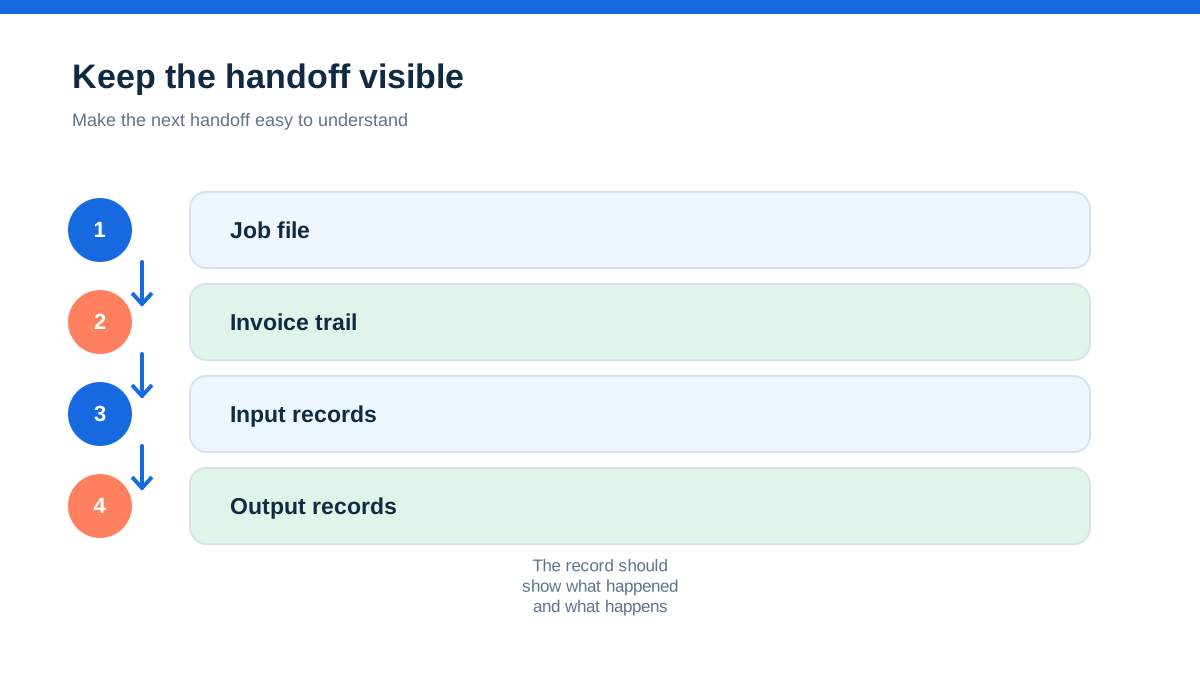
The useful idea is simple: make each job capable of being reconstructed by somebody who did not attend the site. That person might be your bookkeeper, an HMRC officer, a new owner or you six years from now. The record should show what happened, not merely the final amount.
The kitchen extension that looked fine until the records were opened
Imagine a small building firm that completes a kitchen extension. The customer paid a deposit, the firm bought timber and appliances, a subcontractor sent an invoice, the customer changed the specification, and the final invoice included labour, materials and a credit for a returned item. The accounting screen shows one sales invoice and two purchase invoices. The bank feed shows three payments.
That screen does not answer several important questions. When did the supply take place? Which work was standard-rated, reduced-rated or outside a special rule? Was the customer an end user for construction reverse charge purposes? Did the credit note refer to the original invoice? Were the materials bought for this job or another one? Was input VAT supported by a valid invoice? Which amount went into the VAT account?
The aha is that VAT confidence comes from a connected record, not from having a sophisticated dashboard. A simple system can be reliable if it preserves the connection between source documents and the return. A feature-rich system can be weak if staff overwrite descriptions, upload only bank transactions or cannot explain adjustments.
Use that idea as the design test for every software choice and every office routine: can the business trace a figure on the VAT return back to a real supply and forward to the evidence that supports it?
Start with the UK boundary before choosing a folder or app
VAT is a UK tax, but the facts around a trade business are not identical across the four nations. Building regulations, customer contracts and local notification processes may differ even when the VAT record is similar. Great Britain has its own post-transition records for goods moving to or from the European Union. Northern Ireland businesses can have additional EU goods information in their VAT account and special invoice details for certain supplies to EU member states.[1][2]
This article does not attempt to explain every place-of-supply or import rule. It covers the record architecture for a UK trade business that charges or reclaims UK VAT. If the business trades in goods between Northern Ireland and the EU, imports materials, makes digital or cross-border services, or uses a special scheme, add the relevant HMRC guidance to the file before relying on a general workflow.
The registration trigger is also not the same as a simple total of all money received. GOV.UK describes taxable turnover as the value of supplies that are not VAT exempt or out of scope, and includes zero-rated and reduced-rated supplies. It also lists reverse charge transactions and certain other categories in the calculation.[4] A tradesperson watching only bank receipts can therefore miss the point at which registration becomes necessary or classify the wrong transactions.
Record the following at the top of your internal VAT control sheet:
- business legal name and VAT registration number;
- principal place of business and the nations in which work is supplied;
- VAT scheme and accounting periods;
- whether the business works under the Construction Industry Scheme;
- whether it supplies or receives construction services affected by domestic reverse charge;
- whether it has Northern Ireland and EU goods movements;
- who reviews VAT coding and who submits the return.
That short header prevents a generic software template from becoming an accidental tax policy.
The VAT account is the bridge, not the whole landscape
HMRC says a VAT-registered business must keep a VAT account. It summarises output VAT, input VAT, the amount payable or reclaimable and, where relevant, the flat-rate percentage and turnover. HMRC also expects normal business records to be complete, up to date and sufficient to calculate the correct amount.[1][2]
For a trade business, the VAT account is therefore a bridge between detailed job records and the return. It is not a substitute for those job records. Keep the documents that explain the bridge, including:
- quotes, accepted variations and orders;
- job sheets, delivery notes and completion records;
- sales invoices, cancelled invoices and credit notes;
- supplier invoices, receipts and import documents;
- subcontractor invoices and CIS evidence where relevant;
- payment records, refunds, deposits and retentions;
- correspondence that changes the scope, customer or VAT treatment;
- calculations and approvals for manual adjustments;
- the VAT return, submission confirmation and payment evidence.
The precise set depends on what the business normally creates. HMRC says the meaning of business records is wide and may include accounts, bank records, cash books, orders, delivery notes, purchase and sales books, correspondence and documents supporting special VAT treatment.[1] Do not create paperwork that has no business purpose merely to satisfy a checklist. Do preserve the records the job naturally produces, and make sure they remain findable.
A useful naming convention is `YYYY-MM-DD_job-number_document-type_customer`. The convention is not a legal requirement. Its value is that a person can find the invoice, variation and delivery note without relying on the memory of the person who created them.
Give every job a VAT record card before the invoice exists
The hands-on method in this guide is a job VAT record card. It can be a controlled spreadsheet linked digitally to accounting software, a field in job management software, or a paper prompt that is entered into the accounting system before the return. It is not a replacement for the required records. It is the index that keeps them together.
Create one card per job with these fields:
| Field | What to capture | | --- | --- | | Job identity | Unique job number, customer, site address and contract reference | | Supply description | Plain description of the work and materials, not only a code | | Customer status | Consumer, VAT-registered business, contractor, end user or unknown pending confirmation | | Dates | Quote, acceptance, work completed, invoice, payment and any advance payment | | VAT treatment | Rate, exemption or reverse charge reason, with the source or approval note | | Sales evidence | Quote, variation, delivery record, invoice, credit note and proof of issue | | Cost evidence | Supplier invoices, receipts, imports, subcontractor records and job allocation | | Adjustments | Discounts, deposits, bad debt, private use, corrections and who approved them | | Return link | VAT period, return line or code and submission reference |
At job opening, fill in the identity and expected supply type. During the job, attach changes rather than editing history away. At completion, confirm the dates and tax treatment. At return preparation, use the card to locate missing evidence and investigate unusual totals.
The aha of the card is that it makes a missing record visible before the return. A blank field is a prompt for a question. A deleted note is invisible. Software that cannot retain a history of corrections may still be useful, but the business needs a separate controlled record for decisions that affect VAT.
Keep the card proportionate. A one-hour domestic repair does not need a building-project dossier. A multi-stage contract with deposits, materials, subcontractors and variations needs more context than a single invoice line.
Let the tax point change the way the site diary works
A trade business often thinks in terms of when a job is finished. VAT can require more precise timing. GOV.UK explains that the tax point determines which VAT period a transaction belongs to. It is commonly linked to the date of supply, invoice or advance payment, and different rules can apply to particular trades, including building and construction.[2]
That matters when a customer pays a deposit in advance, when an invoice is issued before completion, when a job is split into stages or when a retainer remains unpaid. The job card should not merely record a completion date. It should show the event that drove the accounting treatment and the evidence for that event.
Add a tax-point note when any of these occur:
- an advance payment arrives before work starts;
- an invoice is issued before the work is complete;
- a contract has milestones or staged billing;
- a customer accepts a variation after the original quote;
- a credit note changes a prior invoice;
- cash accounting or another VAT scheme changes the timing;
- a construction reverse charge decision is made.
For ordinary services, a practical note might read: `Work completed 18 May, invoice issued 20 May, no earlier payment, included in June VAT period`. It is not a magic formula for every transaction. It is a clear explanation of the business decision, which an adviser can challenge or confirm.
Do not use the bank-feed date as a universal tax point. Bank feeds are useful evidence of payment, but they are not a complete description of the supply.
Treat construction reverse charge as a customer-and-scope decision
For building and construction work, software may offer a reverse-charge tick box. That box is helpful only after the business has established that the rule applies. HMRC says the domestic reverse charge generally concerns specified building and construction services supplied between UK VAT-registered businesses where payments are reported within the Construction Industry Scheme, subject to exclusions such as end user or intermediary status and other conditions.[5][6]
The relevant record is not simply `reverse charge: yes`. Preserve the reasoning:
- what service was supplied;
- whether it is within the construction operations covered by the rule;
- the supplier and customer VAT status;
- whether the payment is reported within CIS;
- whether the customer gave written end-user or intermediary confirmation;
- the tax point;
- the wording or reference used on the invoice;
- the VAT Return treatment.
HMRC says a reverse-charge invoice must make clear that the customer accounts for the VAT and should show the required invoice information. The amount of VAT accounted for may be stated, but it must not be included in the total VAT charged to the customer.[6] A system that prints a normal VAT invoice with a zero amount because someone selected a generic `zero-rated` code is not doing the same thing.
Build a customer-status field that cannot be left blank for relevant construction jobs. Attach the written confirmation rather than recording only a verbal recollection. If the scope is mixed, ask whether the system can represent the affected lines and the reasoning behind them. If it cannot, use a controlled manual review before sending the invoice.
This article does not decide whether a particular trade supply falls within the reverse charge. It gives a record method. Use the current HMRC construction guidance or an adviser when the customer, contract or service is unclear.
Make purchase evidence survive the van, the inbox and the phone camera
Input VAT is supported by purchase evidence, not by the fact that money left the business bank account. GOV.UK says the business must keep invoices it receives and that it cannot reclaim VAT using an invalid invoice, pro-forma invoice, statement or delivery note. It also says the purchase invoice is primary evidence for recovering VAT incurred.[2]
A trade business needs a routine that works when a supplier invoice arrives as a PDF, a paper receipt goes into a van, and a subcontractor sends a document through a messaging app. The routine can be simple:
- Give the document a unique inbox reference.
- Capture the supplier, date, invoice number, description, net value, VAT and gross value.
- Link it to the job or overhead category.
- Check that the document is an invoice or other valid evidence for the intended claim.
- Record the payment or liability without replacing the source file.
- Flag duplicates, missing VAT numbers, credit notes and private-use items.
- Preserve the original where format or authenticity matters.
Do not let optical character recognition silently decide the VAT rate. Treat automated capture as a suggestion to review. A material supplier invoice with an unexpected rate, a subcontractor invoice with reverse-charge wording or a receipt that combines business and private purchases deserves human attention.
Keep a short exceptions log. The log might show `supplier invoice received without VAT detail, queried 12 June, corrected invoice attached 15 June`. This is more useful than a later unexplained journal.
Join software without breaking the digital link
A job system and an accounting system can divide work, but the connection between them must be understood. GOV.UK says businesses required to keep digital VAT records must use functional compatible software for the electronic account. Where more than one product is used, the records must be linked digitally. The keeping VAT records guidance says manual transfer or copy and paste is not a digital link, while examples of digital transfer include formulas, email, portable devices and XML or CSV import and export in the circumstances described by HMRC.[1][2]
The practical question is not whether two logos appear on an integrations page. Ask what moves, when it moves and what remains in the source system. Test a real sample containing:
- one normal sale;
- one purchase with input VAT;
- one credit note;
- one advance payment;
- one reverse-charge transaction if relevant;
- one adjustment with an approval note.
Trace each item from quote or purchase document to accounting entry, VAT account and return. Then export the records and ask whether the receiving file retains enough description to identify the original transaction. If the connection is a one-way summary, keep the detailed evidence in the source system and record how the summary is reconciled.
A spreadsheet can have a role in a controlled workflow, but a spreadsheet that is manually retyped from an app is a warning sign. Document the interface, the transfer frequency, the person who checks it and the exception process when the sync fails.
Reconstruct one completed job before trusting the quarter
A powerful review is a reconstruction drill. Pick a completed job at random and pretend the business has received a query about the VAT amount. Give the reviewer only the job number and the accounting entry. Ask them to find:
- the accepted scope and any variations;
- the date and nature of the supply;
- the issued sales invoice and any correction;
- the customer VAT or end-user evidence where relevant;
- the material and subcontractor costs;
- the payment and any deposit;
- the VAT coding and return period;
- the approval for unusual treatment.
Time the exercise if useful, but do not turn speed into the only metric. The real result is the gap list. If the reviewer cannot tell whether a material purchase belongs to the job, improve the allocation field. If they can find the invoice but not the customer confirmation, improve the document link. If the tax point is inferred from a bank feed, improve the job diary.
Run the same drill on a cancelled invoice, a credit note and a job with a deposit. These are the records most likely to expose weak history because a clean final invoice hides the earlier event.
HMRC says records must generally be retained for at least six years for VAT purposes, and other tax rules may require longer retention.[1][2] Retention is not the same as accessibility. A backup that cannot be opened, searched or connected to the VAT account is a poor audit trail. Test exports and restore access before changing software.
Know what a software screen cannot decide for you
Software can store a rate, calculate a total, create an invoice, connect data and show a report. It cannot decide whether a particular supply is taxable, whether a construction customer is an end user, whether an invoice is valid evidence, or whether the business has described the work accurately. It also cannot make an incorrect source record correct merely by submitting it electronically.
HMRC says that outsourcing electronic invoice creation or storage does not remove the business's legal obligations for invoice content, storage and production.[3] Treat the provider as part of the control environment, not as a substitute for ownership.
Ask an adviser before relying on a treatment involving:
- mixed supplies or a change in the customer's use of a building;
- reduced or zero rating that depends on property facts or certificates;
- construction reverse charge and end-user status;
- imports, Northern Ireland and EU goods movements;
- cash accounting, flat rate or other special schemes;
- bad debt relief, private use or large corrections;
- a business sale, closure or transfer between software systems.
If the business is not VAT registered, this article does not create an obligation to issue VAT invoices or keep a VAT account. Registration can be voluntary or mandatory under the current GOV.UK rules, and the threshold is not a universal answer for every business structure or transaction.[4]
The record card is the small habit that changes the return review
A trade business does not need to turn every job into a legal case file. It does need enough connected evidence to explain its VAT numbers. The job VAT record card provides a practical middle layer between the field team and the return. It captures identity, dates, treatment, documents, adjustments and the return link while the facts are still available.
The finished test is not `does the app have VAT?` It is `can an informed outsider reconstruct this job and understand why the VAT was treated this way?` If the answer is no, add the missing field, document or review control before adding another automation.
Review current HMRC guidance before acting on thresholds, periods, rates or special rules. Keep the source pages alongside the internal VAT policy and record when they were checked. Where the facts are uncertain, pause the invoice or return review and obtain advice rather than letting a default code make the decision.
Affiliate status: no affiliate links are used on this page. Provider links are direct sources only, pending programme approval.